Sublimation vs Evaporation: Understanding the Key Differences
Introduction to Phase Transitions
Have you ever wondered why dry ice creates that eerie fog without melting into a puddle first? Or why your clothes dry on the clothesline even on a cold day? These everyday phenomena demonstrate two fascinating phase transitions in chemistry: sublimation and evaporation. Both processes transform matter into gas, but they follow distinctly different pathways.
When I first studied these concepts in chemistry class, I was amazed at how these processes explain so many natural occurrences around us. The science behind these phase transitions isn't just academic knowledge—it has practical applications in industries ranging from food preservation to pharmaceutical manufacturing.
In the world of chemistry, phase transitions describe how matter changes from one state to another. The three main phases of matter—solid, liquid, and gas—can transform into each other under specific conditions of temperature and pressure. Phase transitions are the processes that facilitate these transformations, and they're governed by the fundamental principles of thermodynamics.
This comprehensive guide explores the mechanisms, characteristics, applications, and key differences between sublimation and evaporation. By understanding these processes, you'll gain deeper insight into the behavior of matter and the fascinating world of physical chemistry. Let's dive in!
What is Sublimation?
Sublimation is a remarkable process where a solid transforms directly into a gas without passing through the liquid phase. This phase transition might seem unusual, but it occurs more commonly than you might think. Sublimation happens when molecules in a solid gain enough energy to break their rigid bonds and escape directly into the gaseous state.
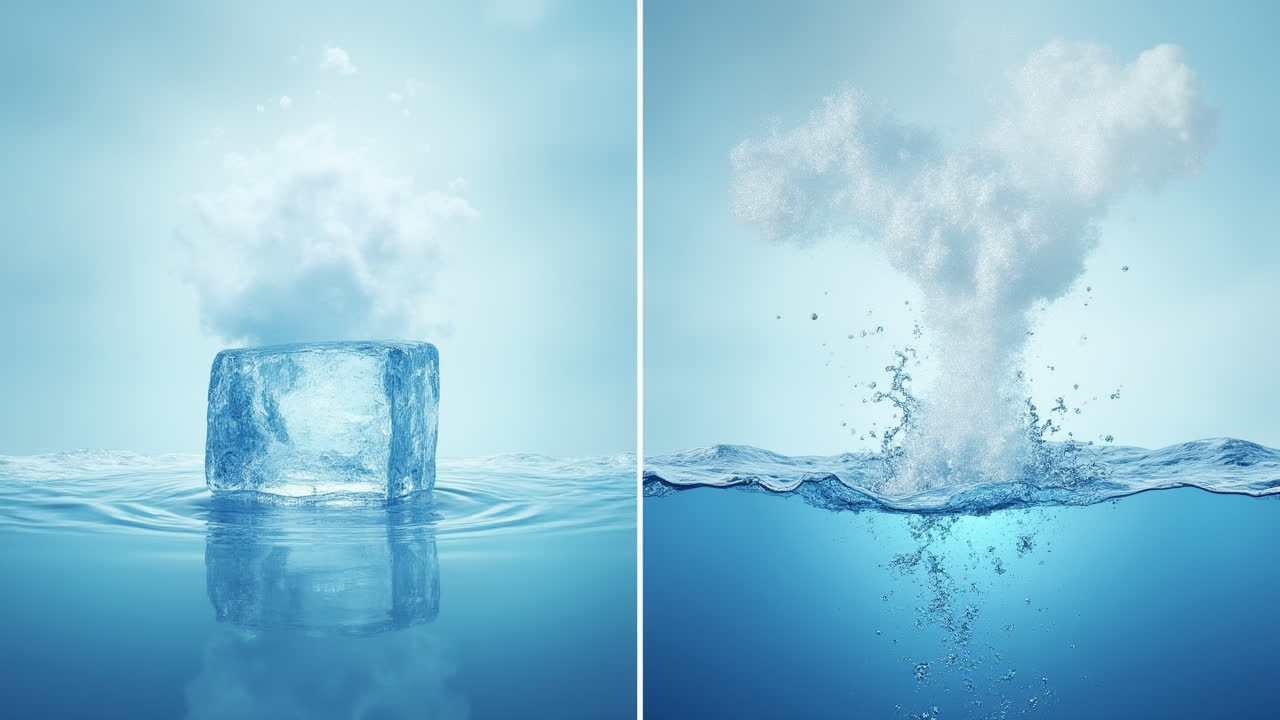
Think about opening your freezer after several months and noticing that ice cubes have shrunk even though they haven't melted. That's sublimation in action! The water molecules transition directly from ice (solid) to water vapor (gas) without becoming liquid water first. This process is particularly noticeable in very cold, dry environments where the humidity is low.
For sublimation to occur, specific temperature and pressure conditions must exist. Specifically, sublimation happens when the substance is below its triple point—the precise temperature and pressure where all three phases (solid, liquid, and gas) can coexist in equilibrium. Below this point, the substance can transition directly between solid and gas states.
As with many phase transitions, sublimation is an endothermic process, meaning it requires energy input. The energy needed to convert a substance from solid to gas without passing through the liquid phase is called the enthalpy of sublimation. This value is typically greater than the enthalpy of vaporization since it includes both the energy needed to break the solid structure and the energy to convert to gas.
Common Examples of Sublimation
- Dry Ice (Solid Carbon Dioxide): Perhaps the most familiar example, dry ice sublimates at -78.5°C under normal atmospheric pressure, creating the characteristic "fog" effect used in special effects.
- Naphthalene (Mothballs): These solid balls gradually sublimate, releasing a gas that repels moths.
- Iodine Crystals: When heated, solid iodine transforms directly into a purple vapor.
- Frozen Water in Cold, Dry Conditions: In Antarctica or high mountains, snow and ice can sublimate without melting.
- Freeze-Dried Foods: The freeze-drying process utilizes sublimation to remove water from frozen food while preserving its structure.
Sublimation has numerous practical applications beyond these examples. It's used in chemical purification processes, in forensic science for fingerprint development, and even in 3D printing technologies. The unique property of bypassing the liquid phase makes sublimation particularly valuable in situations where liquid formation would be problematic or destructive.
What is Evaporation?
Evaporation is a more familiar phase transition that we encounter daily—it's the process by which a liquid transforms into a gas or vapor. Unlike boiling, which occurs throughout the liquid, evaporation takes place only at the surface where liquid molecules with sufficient energy can escape into the air.
Have you noticed that puddles disappear on warm days even when the temperature is below water's boiling point? That's evaporation at work! Molecules in a liquid have varying energy levels. Those with higher energy at the surface can overcome the attractive forces holding them in the liquid state and escape as gas molecules.
Like sublimation, evaporation is an endothermic process requiring energy input, typically in the form of heat from the surroundings. This is why evaporating liquids create a cooling effect—they absorb heat from their environment. The energy required for evaporation is known as the enthalpy of vaporization or heat of vaporization.
Interestingly, evaporation occurs at any temperature above freezing, not just at the boiling point. The rate of evaporation increases with temperature, but other factors also play significant roles in determining how quickly a liquid evaporates.
Factors Affecting Evaporation Rate
- Temperature: Higher temperatures increase molecular energy, accelerating evaporation.
- Surface Area: A greater exposed surface allows more molecules to escape, increasing evaporation rate.
- Air Flow: Moving air carries away evaporated molecules, preventing saturation and maintaining the concentration gradient.
- Humidity: Lower humidity (less water vapor in the air) promotes faster evaporation.
- Intermolecular Forces: Liquids with weaker intermolecular attractions (like alcohol) evaporate more readily than those with stronger bonds (like water).
- Pressure: Lower atmospheric pressure reduces the energy needed for molecules to escape, enhancing evaporation.
Evaporation is essential in countless natural processes and human applications. It drives the water cycle on Earth, influences climate patterns, and enables cooling mechanisms in plants and animals. In daily life, we utilize evaporation for drying clothes, cooling our bodies through perspiration, concentrating solutions, and in numerous industrial processes from food production to pharmaceutical manufacturing.
Comparing Sublimation and Evaporation: A Detailed Analysis
While both sublimation and evaporation result in the formation of a gas, the pathways and conditions for these phase transitions differ significantly. Understanding these differences helps explain why certain substances prefer one transition over the other under specific circumstances.
I once conducted a simple experiment with my students where we observed ice cubes in two different environments—one in a freezer with very low humidity and another in a container at room temperature. The first demonstrated sublimation (shrinking without visible melting), while the second showed the more conventional melting followed by evaporation. This hands-on comparison revealed how environmental conditions determine which phase transition dominates.
The following comparison table highlights the key differences and similarities between these two important phase transitions:
| Characteristic | Sublimation | Evaporation |
|---|---|---|
| Initial Phase | Solid | Liquid |
| Final Phase | Gas | Gas |
| Intermediate Phase | None (direct transition) | Not applicable |
| Energy Requirement | Enthalpy of sublimation (higher) | Enthalpy of vaporization (lower) |
| Conditions | Below triple point | Above freezing point, below/at boiling point |
| Common Examples | Dry ice, camphor, iodine, naphthalene | Water, alcohol, perfume, gasoline |
| Process Location | Throughout the solid | At the liquid surface |
| Rate Dependency | Temperature, pressure, surface area | Temperature, surface area, air flow, humidity |
Both processes are fundamental in numerous scientific and industrial applications. Sublimation is particularly valuable in freeze-drying (lyophilization) for food preservation and pharmaceutical production, where maintaining the structural integrity of the product is crucial. Evaporation, meanwhile, is harnessed in countless processes from distillation to cooling systems.
One fascinating application that utilizes both processes is the production of instant coffee. The process typically involves extracting coffee compounds through liquid extraction (involving evaporation), followed by freeze-drying (utilizing sublimation) to create the final product. This combination produces coffee granules that dissolve readily while preserving flavor compounds.
Practical Applications and Significance
The principles of sublimation and evaporation extend far beyond theoretical chemistry—they have profound practical implications across multiple fields. Let's explore some of the most significant applications of these phase transitions.
Industrial and Scientific Applications of Sublimation
Sublimation's unique property of transitioning directly between solid and gas states makes it invaluable in numerous processes:
- Freeze-Drying (Lyophilization): This technique preserves biological materials, pharmaceuticals, and foods by freezing them and then removing the ice through sublimation under vacuum. The result is a product that maintains its structure while being shelf-stable.
- Chemical Purification: Sublimation can separate compounds based on their different sublimation points, allowing for purification of substances like caffeine, benzoic acid, and various organic compounds.
- Dye-Sublimation Printing: This technology uses heat to transfer dye onto materials such as plastic, card, paper, or fabric. The dye sublimates from solid to gas and then solidifies within the receiving material, creating permanent, high-quality images.
- Forensic Science: Fingerprint development often uses iodine sublimation to reveal latent prints on porous surfaces.
Industrial and Scientific Applications of Evaporation
Evaporation's role in industry and daily life is even more pervasive:
- Concentration of Solutions: From salt production to food processing, evaporation is used to concentrate solutions by removing solvent (typically water).
- Cooling Systems: Evaporative cooling harnesses the endothermic nature of evaporation in air conditioners, refrigerators, cooling towers, and even the human body through sweating.
- Distillation: This crucial separation technique relies on differences in evaporation rates to separate liquid mixtures, with applications ranging from alcohol production to petroleum refining.
- Water Cycle: Perhaps the most significant natural application, evaporation drives Earth's water cycle, affecting everything from weather patterns to ecosystem dynamics.
- Crystallization: Controlled evaporation allows dissolved substances to form crystals, a technique used in sugar production, salt manufacturing, and pharmaceutical development.
Understanding the principles governing these phase transitions enables scientists and engineers to optimize processes, develop new technologies, and solve practical problems. For instance, knowledge of evaporation factors helps in designing more efficient cooling systems, while understanding sublimation conditions is crucial for developing better freeze-drying protocols for vaccines and biological samples.
Even in everyday contexts, this knowledge proves useful. It explains why hanging laundry on a windy day (even a cold one) speeds drying through enhanced evaporation, or why ice cubes left too long in the freezer shrink through sublimation. These seemingly simple processes reveal the elegant physical principles that govern matter's behavior.
Frequently Asked Questions About Sublimation and Evaporation
Can sublimation and evaporation occur simultaneously?
Yes, sublimation and evaporation can occur simultaneously in certain systems containing both solid and liquid phases of the same substance. For example, in partly melted ice, the solid portion can undergo sublimation while the liquid portion evaporates. This is common in nature, especially during seasonal transitions. However, for a single particle or molecule, only one phase transition can occur at a given moment—it either sublimates from solid to gas or evaporates from liquid to gas.
Why do some substances readily sublimate while others prefer evaporation?
A substance's tendency to sublimate versus evaporate depends primarily on its molecular structure, intermolecular forces, and the environmental conditions. Substances with weak intermolecular forces in the solid state but strong vapor pressure (like dry ice or iodine) tend to sublimate more readily. Additionally, environmental conditions matter significantly—substances are more likely to sublimate when the pressure is below their triple point. Molecules with strong hydrogen bonding or those that form tight crystal structures usually prefer the traditional melting-then-evaporation pathway under normal conditions.
How are sublimation and evaporation relevant to climate science?
Both processes play crucial roles in climate science. Evaporation drives the water cycle, influences humidity levels, and affects cloud formation and precipitation patterns. When water evaporates, it absorbs heat, creating a cooling effect that impacts local and global temperature dynamics. Sublimation, while less prevalent, is significant in polar and high-altitude regions where snow and ice can sublimate directly to water vapor. This affects snow cover, glacier mass balance, and polar albedo (reflectivity), which in turn influence climate feedback loops. Understanding these processes is essential for accurate climate modeling and predicting the impacts of climate change on polar ice reserves and water resources.
Conclusion
Sublimation and evaporation represent two fascinating pathways by which matter transforms into the gaseous state. While both processes result in the same endpoint—molecules escaping into the gas phase—they follow distinctly different routes. Sublimation bypasses the liquid phase entirely, offering a direct solid-to-gas transition, while evaporation represents the more familiar liquid-to-gas process.
These phase transitions aren't merely academic concepts—they're essential phenomena that shape our natural world and enable countless practical applications. From the water cycle that sustains life on Earth to advanced manufacturing techniques like freeze-drying and dye-sublimation printing, these processes underpin both natural systems and human technologies.
By understanding the mechanisms, conditions, and factors that influence sublimation and evaporation, we gain deeper insight into the behavior of matter. This knowledge helps explain everyday observations—from disappearing ice cubes in freezers to drying puddles after rain—and informs scientific innovations across disciplines.
The next time you witness dry ice creating its characteristic fog or watch clothes drying on a line, take a moment to appreciate the elegant physical chemistry at work. These commonplace examples of sublimation and evaporation reveal the fascinating ways matter transforms in response to its environment—continuing the endless cycle of phase transitions that has shaped our world for billions of years.