S Orbital vs P Orbital: Key Differences in Atomic Structure
S Orbital vs P Orbital: Understanding the Fundamental Differences
When diving into the fascinating world of atomic structure, understanding the nature of electron orbitals becomes essential for grasping how atoms behave and form chemical bonds. Among these, the S orbital and P orbital represent two of the most fundamental orbital types that determine an atom's properties and its ability to interact with other atoms. But what exactly makes these two orbital types different?
At the heart of atomic theory lies the concept that electrons don't follow precise paths but instead exist within probability clouds around the nucleus. This phenomenon, explained by the Heisenberg Uncertainty Principle, means we can only describe regions where electrons are most likely to be found—these regions are what we call orbitals. While both S and P orbitals play crucial roles in determining an atom's chemical properties, they differ significantly in their shape, energy levels, and behavior.
In this comprehensive guide, we'll explore the distinctive characteristics of S and P orbitals, their importance in chemical bonding, and how they influence an atom's interactions. Whether you're a chemistry student or simply curious about the building blocks of matter, understanding these orbital differences provides a window into the quantum mechanical foundation of our physical world.
What is an S Orbital?
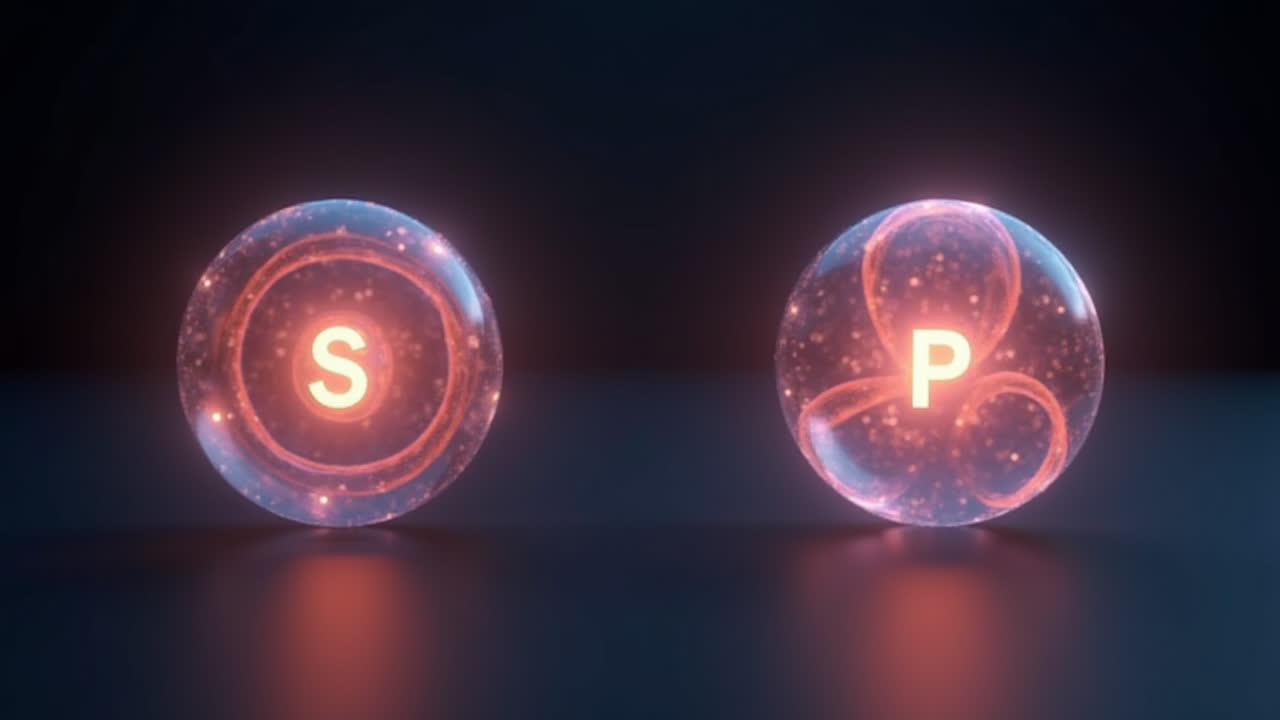
An S orbital represents the simplest type of atomic orbital found in an atom. Its name derives from the term "sharp," which describes the spectroscopic lines associated with electrons in this orbital. The most striking feature of an S orbital is its perfectly spherical shape, creating a probability cloud that surrounds the nucleus evenly in all directions.
Each electron shell in an atom contains at least one S orbital, and each S orbital can accommodate a maximum of two electrons. These paired electrons must have opposite spins according to the Pauli exclusion principle. The spherical nature of S orbitals means they have no angular nodes—regions where the probability of finding an electron drops to zero. Consequently, S orbitals have an angular momentum quantum number of 0.
One fascinating aspect of S orbitals is how they grow in size as the principal quantum number increases. This means that electrons in higher-energy S orbitals (like the 3s compared to 2s) are likely to be found farther from the nucleus, though they maintain the same spherical distribution. Despite their larger size at higher energy levels, S orbitals always retain the lowest energy compared to other orbital types within the same electron shell.
When it comes to chemical bonding, S orbitals participate actively in the formation of sigma (σ) bonds—the strongest type of covalent bond. However, due to their symmetrical nature, they cannot form pi (π) bonds. This limitation plays a significant role in determining which elements can form certain types of chemical bonds and explains many patterns we observe in molecular structures.
What is a P Orbital?
P orbitals present a striking contrast to S orbitals with their distinctive dumbbell shape. The name "P" comes from "principal," reflecting the angular momentum characteristics of electrons occupying these orbitals. Unlike the simple spherical S orbitals, P orbitals have a more complex structure consisting of two lobes extending in opposite directions along an axis, with a node (zero probability region) at the nucleus.
A complete set of P orbitals includes three sub-orbitals—designated as px, py, and pz—that are oriented perpendicularly to each other along the three spatial axes. Each sub-orbital can hold a maximum of two electrons, meaning a complete P orbital can accommodate up to six electrons total. This arrangement gives atoms with filled P orbitals unique reactivity patterns that define their chemical behavior.
P orbitals exist in all electron shells except the first shell (principal quantum number n=1), which contains only an S orbital. Like S orbitals, P orbitals increase in size with higher principal quantum numbers, allowing electrons in higher energy levels to move farther from the nucleus. Each P orbital contains an angular node, giving them an angular momentum quantum number of 1.
In terms of chemical bonding, P orbitals offer more versatility than S orbitals. They can participate in both sigma bonds (when the bond forms along the axis of the orbital lobe) and pi bonds (when the bond forms through the sideways overlap of P orbitals). This dual bonding capability enables the formation of multiple bonds between atoms, which is essential for compounds like oxygen gas (O₂) or carbon dioxide (CO₂) where double or triple bonds exist.
Key Similarities Between S and P Orbitals
Before diving deeper into their differences, it's worth noting that S and P orbitals do share some important characteristics. They are both fundamental atomic orbitals that describe regions of electron probability according to quantum mechanical principles. Neither represents an actual "path" that electrons follow, but rather statistical likelihood regions where electrons might be found.
Both orbital types serve crucial roles in chemical bonding, particularly in the formation of sigma bonds that form the backbone of molecular structures. Additionally, both S and P orbitals increase in size as the principal quantum number increases, meaning electrons in higher energy levels of either orbital type tend to be found farther from the nucleus on average.
S and P orbitals both follow the Pauli exclusion principle, allowing a maximum of two electrons per sub-orbital, with those electrons having opposite spins. This principle governs how electrons are distributed throughout an atom and ultimately influences the periodic table's organization. Understanding these shared characteristics provides context for appreciating their significant differences.
Comparative Analysis: S Orbital vs P Orbital
| Comparison Point | S Orbital | P Orbital |
|---|---|---|
| Shape | Spherical | Dumbbell-shaped |
| Energy Level | Lowest energy in a given shell | Higher energy than S orbital in same shell |
| Maximum Electrons | 2 electrons | 6 electrons (2 per sub-orbital) |
| Sub-orbitals | None | Three (px, py, pz) |
| Angular Nodes | No angular nodes | Has angular nodes |
| Angular Momentum Quantum Number | 0 | 1 |
| First Appearance | First electron shell (n=1) | Second electron shell (n=2) |
| Chemical Bonding Capability | Forms sigma bonds only | Forms both sigma and pi bonds |
Implications for Chemical Bonding
The structural differences between S and P orbitals significantly impact how atoms form chemical bonds. Have you ever wondered why some elements form multiple bonds while others form only single bonds? Much of this behavior can be traced back to the orbital types available to these elements.
S orbitals, with their spherical symmetry, excel at forming sigma bonds—the strongest type of covalent bond. These bonds result from the head-on overlap of orbitals along the internuclear axis. Every chemical bond contains at least one sigma bond as the primary connection between atoms. Elements with only S orbitals in their valence shell, like hydrogen and helium, are limited to forming single bonds.
P orbitals, on the other hand, bring much more versatility to chemical bonding. Their unique dumbbell shape allows them to form both sigma bonds (when aligned along the bond axis) and pi bonds (when oriented perpendicular to the bond axis). This dual capability enables elements with P orbitals to form double and triple bonds, which are common in organic chemistry and explain the rich diversity of carbon compounds.
The bonding differences explain why the periodic table shows such distinct patterns in chemical behavior. Elements in the s-block (Groups 1-2) form primarily ionic or polar covalent bonds, while elements in the p-block (Groups 13-18) create a wide range of covalent structures with varying bond orders. I've always found it fascinating that something as fundamental as orbital shape can explain so much about the molecular world around us.
Frequently Asked Questions
Why can't S orbitals form pi bonds?
S orbitals cannot form pi bonds because of their spherical symmetry. Pi bonds require sideways overlap of orbitals, which is only possible with orbitals that have lobes extending perpendicular to the bond axis, like P orbitals. The spherical shape of S orbitals means they can only overlap head-on to form sigma bonds, as they lack the directional lobes necessary for the parallel alignment required in pi bonding.
How do S and P orbitals affect an element's position in the periodic table?
S and P orbitals directly determine an element's position in the periodic table. Elements whose valence electrons occupy S orbitals are found in the s-block (Groups 1-2), while elements with valence electrons in P orbitals are located in the p-block (Groups 13-18). This orbital-based organization explains many periodic trends like ionization energy and electronegativity. As we move across a period, electron configurations progress from filling S orbitals to filling P orbitals, accounting for the systematic changes in chemical properties.
Why do P orbitals have higher energy than S orbitals?
P orbitals have higher energy than S orbitals within the same principal quantum level because of their angular momentum and greater distance from the nucleus. The angular momentum in P orbitals (quantum number l=1) creates a centrifugal effect that pushes electrons further from the nucleus on average compared to S orbitals (l=0). Additionally, P orbitals have a node at the nucleus, meaning their electrons spend less time near the positively charged nucleus where they would experience stronger attractive forces. These factors result in P orbital electrons being less tightly bound and therefore higher in energy.
Conclusion
Understanding the differences between S orbitals and P orbitals provides fundamental insight into atomic structure and chemical behavior. While S orbitals are characterized by their spherical shape, P orbitals take on a distinctive dumbbell configuration. This seemingly simple geometric distinction leads to profound differences in energy levels, electron capacity, chemical bonding potential, and ultimately, the properties of elements and compounds.
S orbitals, with their spherical symmetry and absence of angular nodes, represent the lowest energy state for electrons within a shell. In contrast, P orbitals with their angular nodes and directional lobes offer more energetic but also more versatile bonding opportunities. The interplay between these orbital types gives rise to the periodic trends we observe across the elements and explains countless chemical phenomena.
As we continue to explore the quantum mechanical foundations of chemistry, the S versus P orbital distinction remains one of the most crucial concepts for predicting and explaining molecular structure and reactivity. Whether in simple diatomic molecules or complex organic compounds, the shapes and energetics of these fundamental orbitals guide our understanding of the material world at its most basic level.