Insect Wings vs Bird Wings: 8 Key Differences Explained
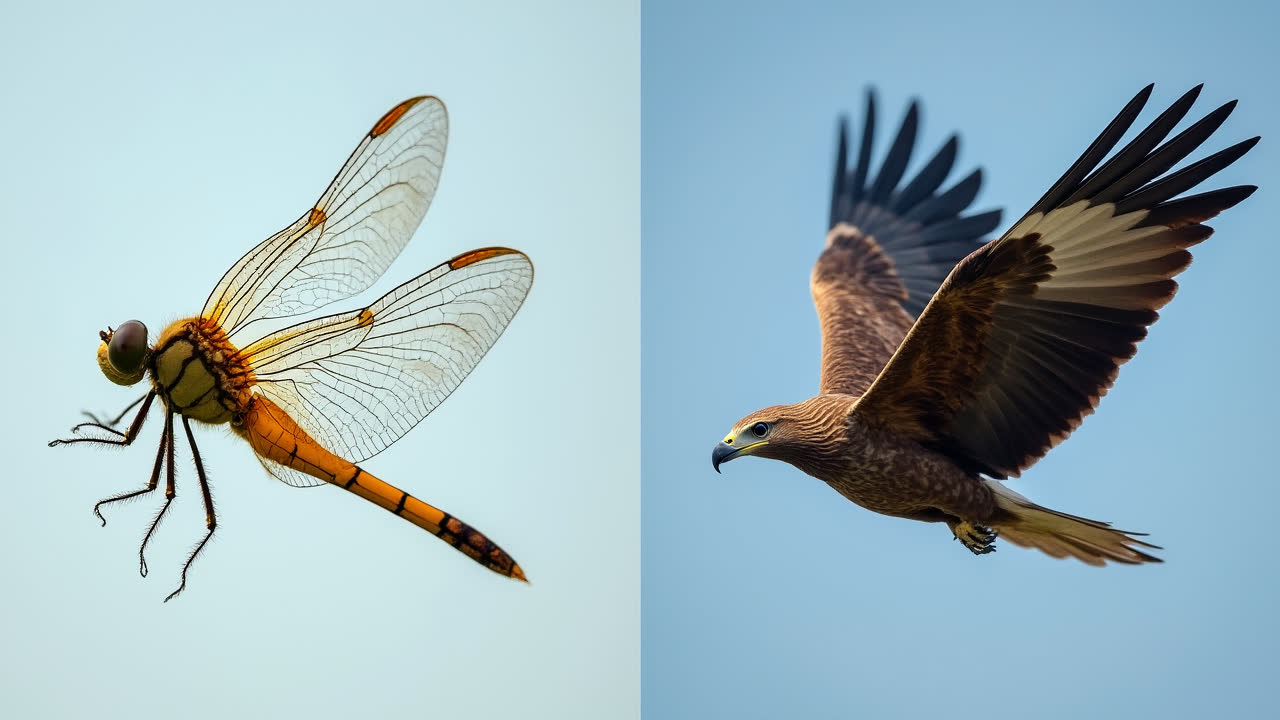
Have you ever wondered how the delicate, transparent wings of a dragonfly differ from the powerful, feathered wings of an eagle? Though both serve the same fundamental purpose—flight—insect wings and bird wings represent two fascinating but completely different evolutionary solutions to conquering the skies. These structures are perfect examples of convergent evolution, where unrelated organisms develop similar adaptations to meet common environmental challenges.
When examining these remarkable flight adaptations up close, the differences become striking and showcase nature's incredible diversity. While insects evolved wings from their exoskeleton, birds developed theirs as modified forelimbs, resulting in fundamentally different structures, mechanisms, and capabilities. This article explores the fascinating contrasts between these two types of wings, their unique features, and what makes each so remarkably effective for their respective owners.
From the microscopic veins that give structure to a butterfly's wings to the complex arrangement of feathers that allows birds to soar for hours, understanding these differences gives us insight into the amazing diversity of flight adaptations in the animal kingdom. Let's dive into the distinctive world of wings and discover what makes each type so special in its own way.
Understanding Insect Wings: Structure and Function
Insect wings are remarkable structures that have helped these small creatures dominate nearly every habitat on Earth. As outgrowths of the insect exoskeleton, these wings don't contain muscles, bones, or other internal structures. Instead, they're essentially flat, membranous extensions that gain their strength and flexibility from a network of veins.
Most insects possess two pairs of wings—forewings and hindwings—that emerge from the second and third thoracic segments. These wings connect to the body at a hinge-like base where wing muscles attach. Rather than having muscles within the wings themselves, insects move their wings by contracting muscles in their thorax that pull on the wing base. This creates a powerful rowing motion that can generate impressive lift for such small creatures.
The pattern of veins in insect wings serves multiple purposes. First, these hollow tubes provide structural support, much like the framework of an umbrella. Second, they contain nerves and tracheae (breathing tubes) that service the wing. Third, the unique pattern of these veins—their number, arrangement, and connections—is so specific that entomologists use them as key identifying features for classifying different insect species.
What's truly remarkable about insect wings is their incredible diversity. From the delicate, scaled wings of butterflies to the hardened forewings (called elytra) of beetles that serve as protective covers, insect wings have adapted to serve numerous functions beyond just flight. Some insects have even lost the ability to fly altogether, with their wings evolving to serve different purposes or disappearing entirely. This diversity of wing types has played a crucial role in making insects the most successful animal group on the planet, with over a million described species.
Understanding Bird Wings: Structure and Function
Unlike insect wings, bird wings are modified forelimbs with a complex internal structure that includes bones, muscles, tendons, and blood vessels. The basic skeletal structure of a bird wing includes three main bones: the humerus (upper arm), and the radius and ulna (forearm). The hand portion consists of fused digits that serve as attachment points for the primary flight feathers.
What makes bird wings truly special is their covering of feathers—lightweight, strong, flexible structures made of keratin (the same protein found in human hair and nails). These aren't simple coverings but sophisticated aerodynamic devices arranged in precise patterns. Primary feathers, attached to the hand bones, provide thrust and control during flight. Secondary feathers, attached to the ulna, create the airfoil shape that generates lift. Additional smaller feathers fine-tune airflow and improve efficiency.
Birds can control their wings with remarkable precision thanks to an intricate network of muscles both within the wing itself and in the chest. The massive pectoral muscles that power downstrokes can make up 15-25% of a bird's total body weight—a testament to the energy demands of powered flight. Unlike insects, birds can adjust the shape of their wings during flight by extending or retracting their joints and manipulating individual feathers.
The design of bird wings varies dramatically based on their flight needs. Eagles and hawks have broad wings with slotted tips for soaring on thermal currents. Falcons have narrow, pointed wings for high-speed pursuit. Hummingbirds have short, blade-like wings for hovering. Each design represents a specialized adaptation to a particular flight strategy and ecological niche, showcasing the incredible versatility of this basic structure.
Key Differences Between Insect and Bird Wings
| Feature | Insect Wings | Bird Wings |
|---|---|---|
| Origin | Outgrowths of exoskeleton | Modified forelimbs (endoskeleton) |
| Number | Typically two pairs (forewings and hindwings) | One pair |
| Structure | Thin membranes supported by network of veins | Bones covered with feathers |
| Movement Mechanism | Muscles at wing base only | Complex muscle system throughout wing |
| Flight Method | Keep body suspended in air | Push body forward through air |
| Surface Covering | Chitin membrane, sometimes with scales | Overlapping feathers |
| Flexibility Control | Limited, mostly fixed shape | Highly adjustable shape and position |
| Taxonomic Class | Insecta | Aves |
Evolutionary Significance: Analogous Structures
The wings of insects and birds represent one of nature's most fascinating examples of analogous structures—similar features that evolved independently in unrelated organisms to serve similar functions. Despite their dramatically different construction, both evolved to solve the same problem: how to achieve powered flight. This phenomenon, known as convergent evolution, demonstrates how natural selection can drive different organisms toward similar solutions when faced with similar environmental pressures.
Insect wings evolved approximately 400 million years ago during the Devonian period, making them the first animals to conquer the skies. The exact evolutionary pathway remains debated, but one leading theory suggests wings developed from gill-like appendages on aquatic ancestors. Over millions of years, these structures were repurposed for aerial locomotion, eventually developing into the diverse wing forms we see today.
Bird wings, in contrast, evolved much later—roughly 150 million years ago during the Jurassic period. They developed from the forelimbs of dinosaur ancestors, specifically theropods, the same group that includes velociraptor and T. rex. Through gradual modifications, these limbs developed feathers (initially for insulation) and eventually became capable of generating lift. The transition from ground-dwelling dinosaur to flying bird represents one of the most studied evolutionary sequences in paleontology.
What makes this convergent evolution so remarkable is that these two groups—insects and birds—took completely different developmental pathways to achieve flight. Insects modified their external covering, while birds repurposed their limbs. Yet both arrived at solutions that allowed them to exploit the same aerial niche, demonstrating how powerful the adaptive benefits of flight must have been to drive such dramatic but parallel anatomical changes in unrelated lineages.
Functional Differences in Flight Mechanics
Despite serving the same general purpose of flight, insect and bird wings operate using fundamentally different mechanical principles. These differences affect everything from flight speed and maneuverability to energy efficiency and endurance. Understanding these functional differences helps explain the distinctive flight patterns we observe in these two groups.
Insects typically fly using a direct flapping motion, with remarkably high wing-beat frequencies. A housefly, for example, can beat its wings approximately 200 times per second, while mosquitoes reach an astonishing 600 beats per second. This high-frequency oscillation allows even tiny insects to generate sufficient lift to overcome gravity. Many insects employ a figure-eight wing pattern that generates lift on both the downstroke and upstroke—a mechanism entirely different from that used by birds.
Birds, meanwhile, primarily generate lift on the downstroke of their wings, using powerful pectoral muscles. Their wings function as airfoils—the same principle used in airplane wings—creating pressure differences that result in lift. The upstroke is primarily a recovery motion, though some birds can generate additional lift during this phase as well. Birds can also lock their wings in an extended position to soar on thermal currents, something insects generally cannot do.
Another critical difference lies in control and maneuverability. Birds can make fine adjustments to their wing shape and position, allowing precise control over flight direction and speed. They use their tail feathers as a rudder and can spread or contract their primary feathers to modify lift. Insects, while often incredibly agile, achieve their maneuverability through different means—primarily by adjusting the timing and power of wing beats rather than changing wing shape.
These mechanical differences explain why, despite both achieving flight, insects and birds occupy different aerial niches. Insects excel at hovering, rapid directional changes, and flying in confined spaces. Birds generally achieve greater speeds, distance, and altitude, with some species capable of transoceanic migrations that would be impossible for insects. Each flight system has its own advantages, perfectly adapted to the ecological needs of its possessors.
Frequently Asked Questions
Why do insects have four wings while birds have only two?
Insects evolved with four wings because their body plan and developmental pathways favored this arrangement. Having separate forewings and hindwings allows for greater specialization—in beetles, for example, the forewings evolved into protective covers (elytra) while the hindwings still provide flight capability. Birds, being vertebrates with a standard tetrapod body plan, evolved flight by modifying their existing forelimbs. Since vertebrates only possess two pairs of limbs (arms and legs), birds could only develop two wings while still retaining their hind limbs for landing, perching, and other essential functions.
Can insect wings heal if damaged?
Unlike bird feathers which can be replaced through molting, insect wings generally cannot heal or regenerate if damaged. Once an insect reaches its adult stage (when wings are fully formed), it typically cannot repair wing damage. This is because insect wings lack blood vessels and the cellular mechanisms needed for healing. Small tears or holes might not significantly impact flight, but substantial damage can be debilitating. This is one reason why many insects have relatively short adult lifespans—their wings gradually deteriorate over time without any ability to repair themselves. Some insects can compensate for minor wing damage by adjusting their flight mechanics, but severe damage often leads to reduced mobility and increased vulnerability to predation.
Which can fly faster: insects or birds?
Birds generally achieve much higher maximum flight speeds than insects. The fastest bird, the peregrine falcon, can reach speeds of over 240 mph (386 km/h) during hunting dives, while even in level flight, many bird species can sustain speeds of 20-40 mph. By comparison, even the fastest insects—like dragonflies and horseflies—typically max out around 20-35 mph for brief periods. This speed differential results from several factors: birds have more powerful muscles relative to their body size, more efficient respiratory systems to sustain aerobic activity, and wing designs optimized for speed. That said, many insects excel in other flight metrics—like acceleration, maneuverability, and the ability to hover—capabilities that some birds (like hummingbirds) have only evolved to match through specialized adaptations.
Conclusion
The striking differences between insect and bird wings showcase nature's remarkable ability to evolve diverse solutions to similar challenges. Despite serving the common purpose of flight, these structures differ fundamentally in their origin, composition, mechanism, and capabilities. Insect wings—thin, membranous extensions supported by a network of veins—evolved from the exoskeleton, while bird wings—complex limbs covered with aerodynamic feathers—represent modified forelimbs.
These differences aren't just anatomical curiosities; they have profound implications for how these animals navigate their environments, escape predators, find food, and disperse to new territories. The distinct flight capabilities provided by each type of wing have helped shape the ecological roles of insects and birds, contributing to their evolutionary success across millions of years.
As we continue to study these remarkable adaptations, they inspire not only biological understanding but also technological innovation. Aerospace engineers and robotics designers increasingly look to nature's flight systems when developing new technologies—from micro-drones inspired by insect flight mechanics to aircraft wing designs that incorporate principles from bird aerodynamics.
In the grand tapestry of evolution, insect and bird wings stand as testament to the creative power of natural selection—turning the challenge of defying gravity into an opportunity for spectacular biological innovation. Though taking different developmental paths, both solutions have proven remarkably successful, enabling these animals to conquer the skies and diversify into countless species that enrich our world.