Echinoderms vs Chordates: 7 Essential Differences Explained
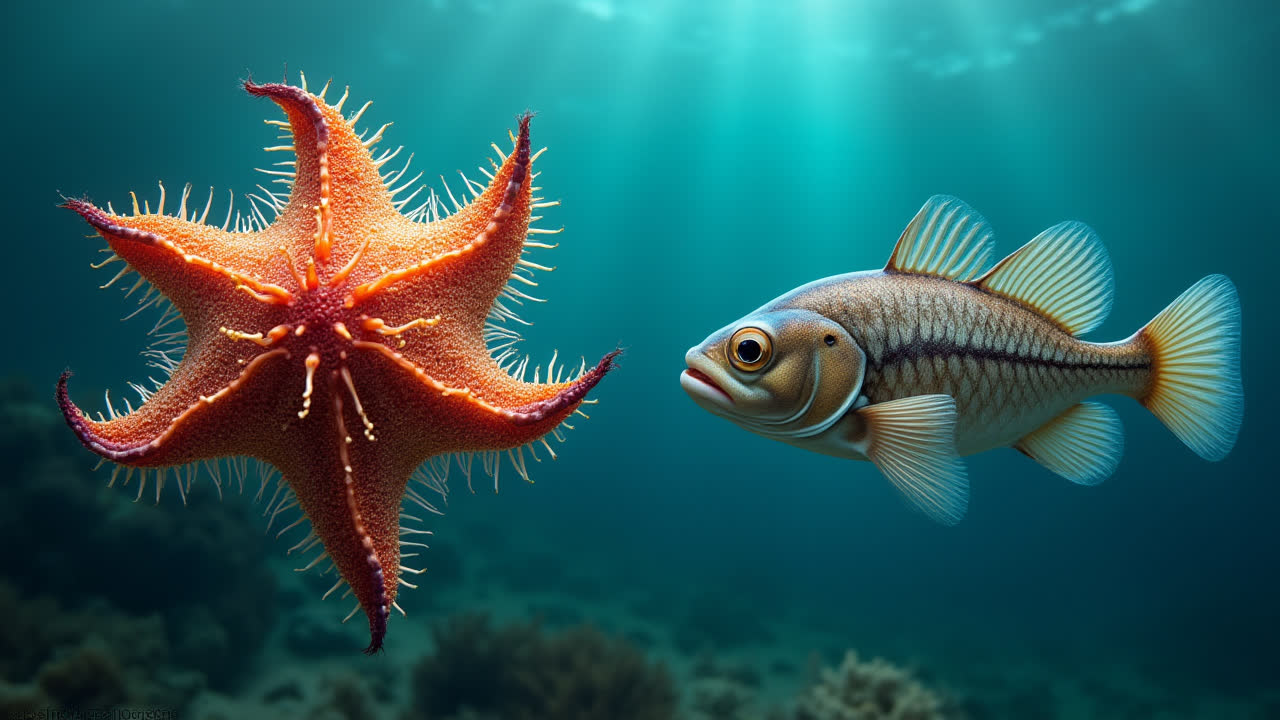
When exploring the vast diversity of animal life, echinoderms and chordates stand out as fascinating groups with distinctive characteristics. Both belong to the clade Bilateria and are deuterostomes, making them more closely related to each other than to many other animal groups. But what exactly sets these two phyla apart? In this article, we'll dive into the key differences that distinguish echinoderms from chordates, from their skeletal structures to their nervous systems and beyond.
Have you ever wondered why a starfish looks so different from a fish? Or why sea cucumbers and humans are classified in completely separate animal groups despite both being deuterostomes? The answers lie in the fundamental biological differences that have evolved over millions of years, creating distinct developmental pathways for these fascinating creatures.
Understanding Echinoderms: The Spiny-Skinned Marine Animals
Echinoderms, whose name literally means "spiny skin," comprise an exclusively marine phylum with approximately 7,000 identified species. These unique invertebrates include familiar creatures like starfish (sea stars), sea urchins, sand dollars, sea cucumbers, and brittle stars. What makes echinoderms particularly interesting is their distinctive pentaradial symmetry as adults – they typically display a five-part body arrangement. This is actually a secondary development, as their larval forms initially show bilateral symmetry before transitioning to the radial pattern during development.
One of the most remarkable features of echinoderms is their water vascular system, a modified coelom called a madreporite. This hydraulic system serves multiple functions, facilitating gas exchange, nutrient circulation, and waste removal. The system connects to numerous tube feet, which echinoderms can extend and retract using hydrostatic pressure, enabling them to move across the ocean floor. Additionally, many echinoderms possess extraordinary regenerative abilities, allowing them to regrow lost body parts – some starfish can even regenerate an entire body from a single arm containing part of the central disc!
Echinoderms have a mesodermal skeleton composed of calcite plates called ossicles, secreted by their epidermal cells. These ossicles can form rigid structures (as in sea urchins) or be loosely connected (as in sea cucumbers), providing different levels of flexibility. The pigment cells in their skin often give echinoderms vibrant colors, making them some of the most visually striking marine creatures. Despite their seemingly simple structure, echinoderms have been tremendously successful evolutionarily, thriving in oceans worldwide from the intertidal zone to the deepest trenches.
Understanding Chordates: From Simple Notochords to Complex Vertebrates
The phylum Chordata encompasses a diverse group of animals united by the presence of four key characteristics at some point in their development: a post-anal tail, a dorsal hollow nerve cord, a notochord, and pharyngeal slits. While these features might seem technical, they represent crucial evolutionary innovations. The notochord, for instance, is a flexible rod-like structure that provides support and serves as the foundation for the development of the vertebral column in more complex chordates.
Chordates can be broadly classified into two main groups: Craniata (Euchordata) and Acrania (Protochordata). Craniates are the more familiar chordates, possessing a skull that protects the brain. This group includes all vertebrates – from fish to amphibians to reptiles, birds, and mammals (including humans). Acraniates, on the other hand, are more primitive chordates lacking a skull, including marine organisms like lancelets and sea squirts. Despite the enormous diversity within Chordata, from the simple lancelet to the complex human, all share those fundamental chordate characteristics, at least during some developmental stage.
Unlike echinoderms, most chordates display bilateral symmetry throughout their lives. They also possess an internal skeleton made of bone and/or cartilage rather than calcite plates. This endoskeleton provides support, protection for vital organs, and attachment points for muscles, enabling the diverse locomotion methods seen across chordate species – from swimming and crawling to walking, running, and flying. Perhaps most significantly, chordates have developed a centralized nervous system, with a brain and spinal cord that coordinate and integrate information from throughout the body.
Key Similarities Between Echinoderms and Chordates
Despite their obvious differences, echinoderms and chordates share several important characteristics that reflect their evolutionary relationship. Both groups are deuterostomes, meaning that during embryonic development, the blastopore (the first opening that forms in the embryo) develops into the anus rather than the mouth. This developmental pattern distinguishes them from protostomes (like arthropods and mollusks) and indicates their shared evolutionary history.
Both phyla also exhibit radial cleavage during early embryonic development, where cell divisions occur parallel or perpendicular to the polar axis. This cleavage pattern is indeterminate, meaning that if early embryonic cells are separated, each can develop into a complete organism. Additionally, both echinoderms and chordates develop through three distinct germ layers – endoderm, mesoderm, and ectoderm – which give rise to different tissues and organs. They also possess a true coelom, a fluid-filled body cavity completely lined with mesoderm, which provides space for organ development and facilitates various physiological functions.
Comparison Table: Echinoderms vs Chordates
| Characteristic | Echinoderms | Chordates |
|---|---|---|
| Body Symmetry | Pentaradial symmetry in adults; bilateral in larvae | Bilateral symmetry throughout life |
| Skeletal System | Mesodermal skeleton made of calcite ossicles | Internal skeleton of bone and/or cartilage |
| Nervous System | Decentralized nerve net without central point | Centralized system with notochord/neural tube |
| Habitat | Exclusively marine environments | All biomes (marine, freshwater, terrestrial) |
| Locomotion | Tube feet operated by water vascular system | Various (fins, legs, wings, etc.) |
| Respiratory System | Dermal gills, tube feet, coelomic surfaces | Gills, lungs, or skin depending on species |
| Examples | Starfish, sea urchins, sea cucumbers | Fish, amphibians, reptiles, birds, mammals |
| Regenerative Ability | Extensive (some can regenerate from fragments) | Limited (varies by species) |
The 7 Major Differences Between Echinoderms and Chordates
1. Skeletal Structure
The most fundamental difference between these phyla lies in their skeletal systems. Echinoderms possess a dermal endoskeleton composed of calcium carbonate plates or ossicles. These ossicles are embedded in the skin and can form a rigid test (as in sea urchins) or be loosely connected (as in starfish). In contrast, chordates have an internal skeleton made of bone and/or cartilage, which provides structural support and protection for internal organs while serving as an attachment point for muscles.
2. Body Symmetry
Adult echinoderms exhibit pentaradial symmetry – a five-part radial arrangement. Interestingly, echinoderm larvae start with bilateral symmetry and undergo a metamorphosis to achieve their adult radial form. This makes echinoderms unique among deuterostomes. Chordates, on the other hand, maintain bilateral symmetry throughout their lives, with distinct anterior (head) and posterior (tail) ends, as well as dorsal (back) and ventral (belly) surfaces.
3. Nervous System Organization
The nervous system constitutes another significant distinction. Echinoderms lack a centralized nervous system, instead possessing a nerve net without any central control point. This decentralized arrangement aligns with their radial symmetry. Chordates, however, feature a highly centralized nervous system consisting of a dorsal hollow nerve cord that develops into the brain and spinal cord, allowing for more complex behaviors and responses.
4. Habitat Distribution
While echinoderms are exclusively marine animals, chordates have successfully colonized virtually every habitat on Earth. You'll find chordates in oceans, lakes, rivers, forests, deserts, grasslands, and even the polar regions. This remarkable adaptability stems from the evolutionary innovations of chordates, particularly those in the vertebrate lineage, which have enabled them to thrive in diverse environments with varying conditions.
5. Locomotion Methods
Echinoderms move primarily using their unique tube feet, which operate through a hydraulic water vascular system. This relatively slow method of locomotion constrains their mobility compared to most chordates. Chordates exhibit diverse locomotion strategies, from the undulating swimming of fish to the bipedal walking and running of humans, reflecting their varied habitats and lifestyles. The internal skeleton and well-developed muscular system of chordates facilitate these diverse movement patterns.
6. Respiratory Mechanisms
Respiratory systems also differ significantly between these groups. Echinoderms lack specialized respiratory organs, instead utilizing dermal gills, tube feet, and coelomic surfaces for gas exchange. This limits them to aquatic environments. Chordates have evolved various specialized respiratory structures – gills in aquatic species, lungs in terrestrial forms, and sometimes specialized skin surfaces – enabling them to extract oxygen efficiently from different media.
7. Circulatory System Complexity
Finally, the circulatory systems of these phyla reflect their different organizational complexities. Echinoderms possess an open circulatory system with coelomic fluid serving multiple functions. Chordates typically have closed circulatory systems with hearts pumping blood through vessels, allowing for more efficient transport of oxygen, nutrients, and waste products throughout the body. This difference in circulatory efficiency partly explains the size limitations of echinoderms compared to many chordate species.
Frequently Asked Questions
Are any echinoderms considered dangerous to humans?
While most echinoderms are harmless to humans, some species can cause injuries. Sea urchins, for example, have sharp spines that can pierce skin and break off, causing painful wounds. Some species have venomous spines that can cause additional symptoms like swelling and nausea. Crown-of-thorns starfish have venomous spines that can cause severe pain, vomiting, and swelling if stepped on or handled improperly. However, fatal encounters with echinoderms are extremely rare, and most injuries can be treated with prompt first aid.
Why are sea cucumbers classified as echinoderms when they don't look spiny?
Despite their soft, elongated bodies that don't appear spiny, sea cucumbers are indeed echinoderms. They possess the defining characteristics of the phylum, including a water vascular system, tube feet, and a skeleton of microscopic ossicles embedded in their body wall. These ossicles are reduced and widely separated compared to other echinoderms, giving sea cucumbers their flexible, cucumber-like appearance. They also exhibit pentaradial symmetry in their internal anatomy and around their mouth, where typically five-fold arrangements of tentacles (modified tube feet) can be observed, confirming their echinoderm classification.
Can you explain why some chordates don't have backbones?
Not all chordates possess backbones (vertebral columns) because the phylum Chordata includes both vertebrates and invertebrate groups. The defining feature of chordates is the presence of a notochord during at least some stage of development, not necessarily a backbone. In vertebrates, the notochord is largely replaced by the vertebral column during development. However, in invertebrate chordates like lancelets (cephalochordates) and tunicates (urochordates), the notochord either persists throughout life (lancelets) or is present only in larval stages before being lost during metamorphosis (most tunicates). These invertebrate chordates represent more evolutionarily ancient lineages that branched off before the evolution of vertebrae, demonstrating the gradual development of chordate characteristics over evolutionary time.
Conclusion
The differences between echinoderms and chordates highlight the diverse evolutionary pathways that deuterostome animals have taken. From their distinct skeletal compositions and body symmetries to their nervous system organizations and habitat preferences, these two phyla exemplify how closely related groups can diverge dramatically through evolutionary time. While echinoderms specialized as primarily benthic marine invertebrates with unique water vascular systems and regenerative capabilities, chordates developed a centralized nervous system and internal skeleton that ultimately enabled some lineages to colonize diverse habitats across the planet.
Understanding these differences not only helps us classify and understand the natural world but also provides insights into evolutionary processes and the diverse solutions that organisms have developed to meet life's challenges. The next time you encounter a starfish on the beach or observe a bird in flight, take a moment to appreciate the fundamental biological differences that have shaped these remarkable creatures over hundreds of millions of years of evolution.
References:
- https://bio.libretexts.org/Bookshelves/Introductory_and_General_Biolog
- http://www.notesonzoology.com/phylum-chordata/classification-of-phylum
- https://en.wikipedia.org/w/index.php?curid=16354608
- http://cnx.org/contents/GFy_h8cu@10.53:rZudN6XP@2/Introduction
- https://commons.wikimedia.org/w/index.php?curid=49934579